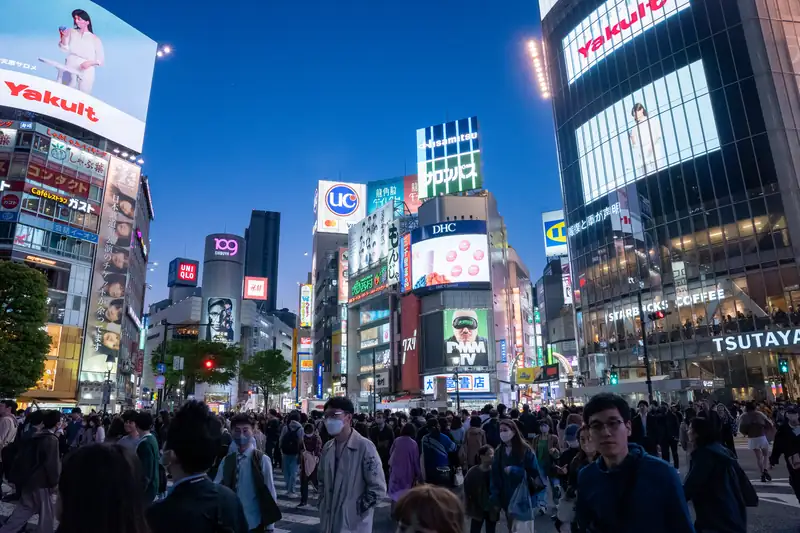
Shibuya Crossing is a free scramble crossing outside Shibuya Station's Hachiko exit, where traffic stops in every direction and more than 1,000 people cross at each change at peak times. It is worth a visit: cross it a few times, then watch from above. Weekday evenings are busy; non-working days busier still.
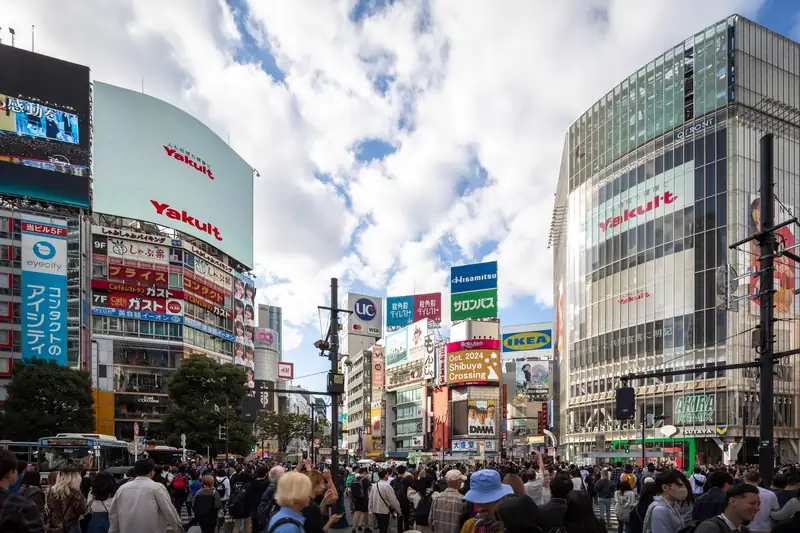
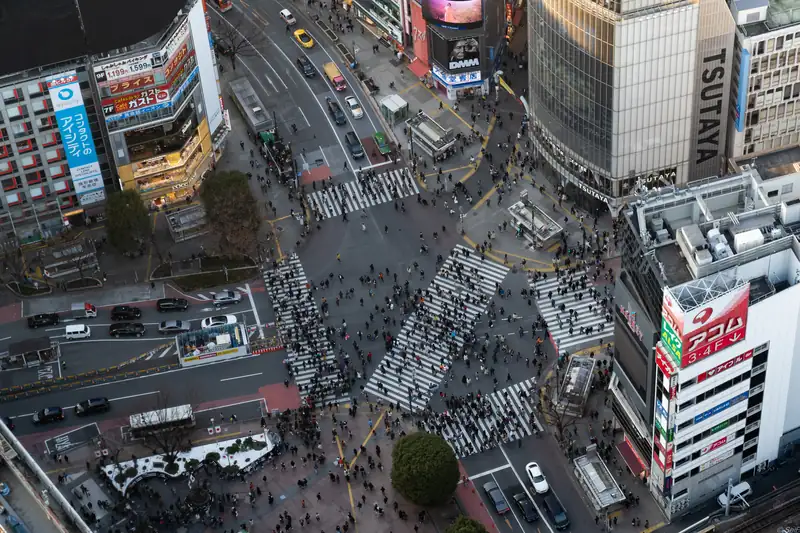
Shibuya Crossing is worth seeing, and it costs nothing. It is the scramble crossing outside the Hachiko exit of Shibuya Station: every few minutes the traffic lights stop cars in all directions at once and the whole junction fills with people walking straight, sideways and diagonally. At peak times more than 1,000 people cross on a single change of the lights, according to GO TOKYO, the Tokyo government’s tourism site.
You need about 15 minutes to cross it a few times and take photos. Add another half hour if you want to watch it from above, which is the part most people remember.
How the scramble works
A “scramble” crossing gives pedestrians the whole junction at once. While the walk signal is green, all vehicle lights are red, so you can cross corner to corner instead of making two trips. When the signal starts flashing, finish crossing and do not start; the cars move as soon as it turns red.
The crossing opened in its scramble form in 1973, according to the Asahi Shimbun. It became a symbol of Tokyo much later, helped by films such as Lost in Translation (2003), whose rain-soaked crossing scene used the video screen on the QFRONT building, and The Fast and the Furious: Tokyo Drift.
What is around the crossing
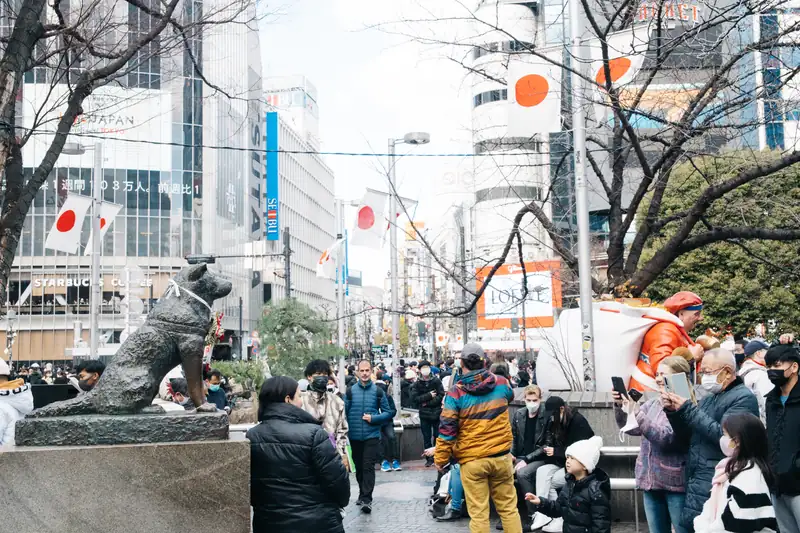
Hachiko Square and the Hachiko statue sit on the station side. Across the junction, the QFRONT building carries the big video screen, with Shibuya TSUTAYA inside and the famous Starbucks on its second floor. MAGNET by SHIBUYA109 has the rooftop view, and the Shibuya 109 fashion building stands opposite the station. Center Gai, the main pedestrian shopping street, runs off the crossing into Udagawacho.
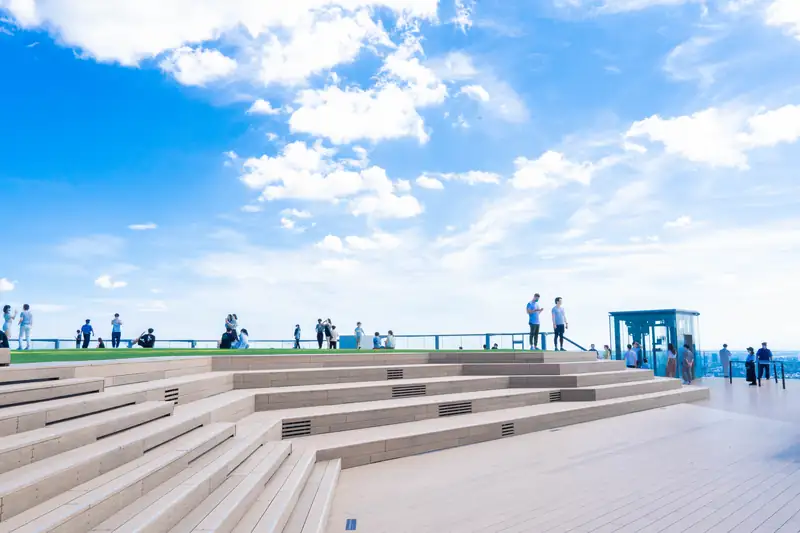
Above it all is Shibuya Scramble Square, the tallest building in the area at about 230 m, with SHIBUYA SKY on its roof. It opened in 2019 and is part of a station rebuild that Japanese press often calls “once in a century”.
How many people cross?
Nobody counts every light. The figures that exist are these:
| Figure |
Source |
| More than 1,000 people per light change at peak times |
GO TOKYO (Tokyo government tourism site) |
| Up to 3,000 per light change |
2016 estimate by the Center Gai shopkeepers’ association, reported by the Asahi Shimbun |
| About 260,000 people a day on weekdays |
2014 flow survey, Shibuya Redevelopment Association |
| About 390,000 people a day on non-working days |
Same 2014 survey |
It is often called the world’s busiest pedestrian crossing. That is a reputation, not a record: no one has published a count comparing it with other big crossings.
Is Shibuya Crossing worth it?
For a first visit to Tokyo, yes. It is free, it is next to one of the city’s main stations, and it takes minutes. The odd thing is that crossing it at street level feels quite ordinary: you see the backs of the people in front of you and then you are across. The scale only shows from above, when you watch the crowd fill the junction and drain away again.
So plan both. Walk it two or three times, then go up to a viewpoint. Our guide to the best view of Shibuya Crossing compares them, from the free Hikarie Sky Lobby to the SHIBUYA SKY rooftop at 229 m.
If you want a guide to show you the crossing and the backstreets behind it, the Shibuya Highlights Walking Tour starts by Hachiko, crosses the Scramble and ends at a lookout in Mark City, in 90 minutes.
The best time to see Shibuya Crossing
It depends on what you want to see.
- Biggest crowds: weekends and public holidays. The 2014 survey counted about half as many people again on non-working days as on weekdays.
- Lights and screens: after dark, when the video screens on the buildings around the junction are lit.
- Easier photos: early morning, before the shops open.
- In the rain: the umbrellas make the best overhead photos, and it is the look Lost in Translation made famous.
Halloween 2026 and New Year
Shibuya City has spent several years discouraging Halloween crowds. For 2026 the ward’s theme is “Goodbye Bad Halloween”, and the measures are dated:
| Date |
Rule |
| Every night |
No drinking on the street or in public places around the station, 18:00 to 05:00 (since 1 October 2024, no fine) |
| Ward-wide since 1 June 2026 |
¥2,000 on-the-spot fine for littering |
| Ward-wide, all year |
¥2,000 on-the-spot fine for smoking outdoors outside designated smoking areas |
| 30 Oct, from 16:00, to early 31 Oct |
Roads around the station closed to vehicles |
| 31 Oct, from 16:00, to early 1 Nov |
Roads closed again; checkpoints as needed |
| 30 Oct to 1 Nov |
Hachiko statue boarded off |
| Night of 31 Oct |
Shops in and around the no-drinking zone asked not to sell alcohol |
The road closures come from the Shibuya City newsletter of 15 October 2026. If you are in Tokyo that weekend, the crossing will be crowded and policed, and 31 October 2026 is a Saturday.
The New Year countdown at the crossing was cancelled again for 2025/26, and the ward had not announced plans for 2026/27 when this page was checked.
How to get there
Leave Shibuya Station by the Hachiko exit and the crossing is in front of you, past the Hachiko statue. The JR, Tokyo Metro Ginza, Keio Inokashira and Tokyu Toyoko lines all serve the station. Since 26 January 2025, JR’s Hachiko Gate is in a new place on the station’s east-west passage, and you can no longer see the statue from it; our Hachiko statue guide explains the walk. For the rest of the station, see the Shibuya Station guide.
The station is being rebuilt, with the last parts due in FY2034, so expect hoardings and walking routes that change from one visit to the next.
Tips for crossing and photographing it
- Stand on the corner by the statue or the QFRONT building and let one cycle pass before you join.
- Do not stop in the middle for a selfie as the signal flashes. Cars wait, but not for long.
- Tripods in the crowd get in the way. If you want a long exposure, use a viewpoint above.
- Keep your bag in front of you at busy times, as you would in any crowd.
For a full afternoon around the crossing, see things to do in Shibuya, and for the evening, Shibuya at night. Other guided walks are on the Shibuya tours page.