Most visitors to Shibuya come for the Scramble Crossing and the Hachiko statue, then go up SHIBUYA SKY, which costs ¥2,700 online before 15:00. Add Center Gai, Miyashita Park, Nonbei Yokocho's tiny bars and the Parco game shops, and one full day covers it. Harajuku and Meiji Jingu are one stop north.
The main things to do in Shibuya fit in one day on foot. Cross the Shibuya Scramble Crossing and see the Hachiko statue, then go up SHIBUYA SKY for the view from 229 m. In between, eat and shop along Center Gai, sit on the rooftop lawn at Miyashita Park and end the night in the tiny bars of Nonbei Yokocho.
Shibuya is both a whole ward of Tokyo and the district around Shibuya Station. This page is about the station district, where nearly everything below is within a 10-minute walk of the crossing. The ward also includes Harajuku, Omotesando, Ebisu and Daikanyama, which get their own section further down.
The sights around the station
| Sight |
Cost |
Time to allow |
| Scramble Crossing |
Free |
15 minutes, longer to watch from above |
| Hachiko statue |
Free |
10 minutes, plus the queue for a photo |
| SHIBUYA SKY |
¥2,700 to ¥3,700 adult (checked October 2026) |
1 to 1.5 hours |
| MAGNET by SHIBUYA109 rooftop |
¥1,800 with one drink, cashless (checked October 2026) |
30 minutes |
| Shibuya Hikarie 11F Sky Lobby |
Free, 7:00 to 24:00 |
15 minutes |
| Myth of Tomorrow mural |
Free |
10 minutes |
| Miyashita Park |
Free to enter |
30 minutes to 1 hour |
| Nonbei Yokocho |
Price of your drinks |
An evening |
Shibuya Crossing
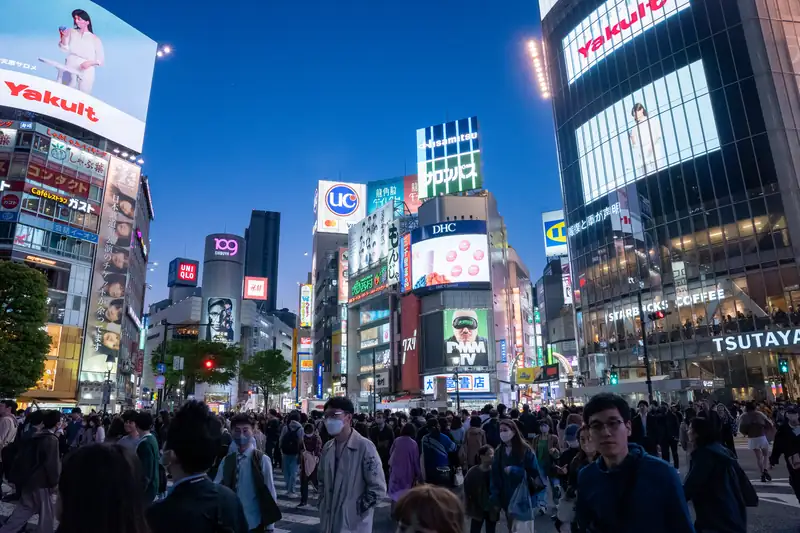
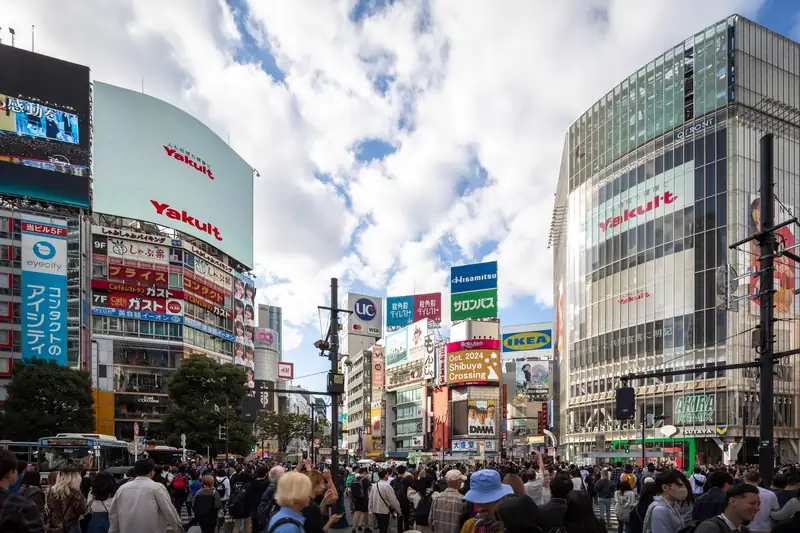
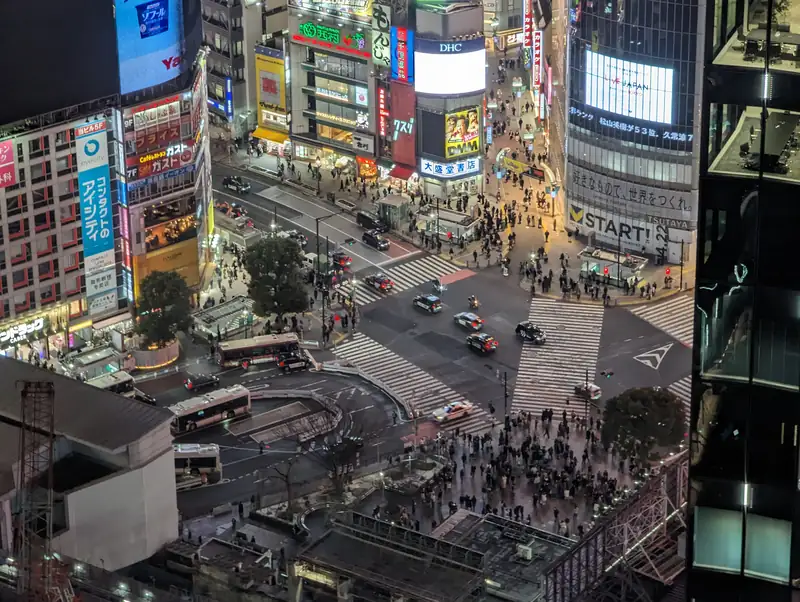
This is the reason most people come. When the lights turn red for cars, they turn green for walkers in every direction at once, and more than 1,000 people can cross on a single change at peak times, according to GO TOKYO, the city’s tourism site. It is often called the world’s busiest pedestrian crossing. Nobody has published a count that proves it, but standing in the middle you will not argue.
Walk it a few times, then watch it from above. Our guide to the best view of Shibuya Crossing compares the free and paid spots, from the Hikarie Sky Lobby to the Starbucks on the second floor of QFRONT.
Hachiko
The bronze Akita on the station square is the second thing on every list. Read the story of Hachiko before you go: the dog kept coming to Shibuya Station for almost ten years after his owner died in 1925, and the statue you see is the 1948 replacement for one melted down during the war. Since January 2025 the JR ticket gate called Hachiko Gate has moved, and you can no longer see the statue from it, so the Hachiko statue guide explains how to find it.
SHIBUYA SKY
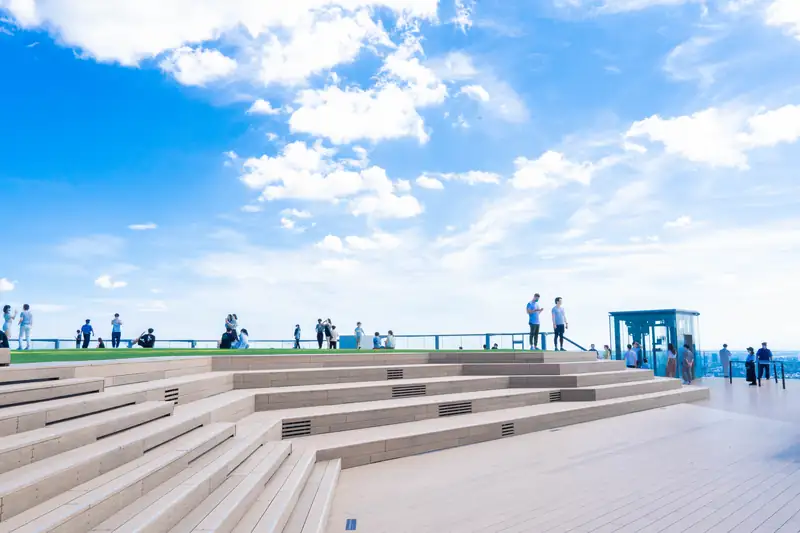
The open-air roof of Shibuya Scramble Square is the best view in Shibuya and one of the best in Tokyo. Tickets are for a 20-minute entry window and go on sale two weeks ahead at midnight Japan time. Slots near sunset are the hardest to get, and on the day this guide was checked (Friday 23 October 2026), the official site said that day’s tickets had already gone. The SHIBUYA SKY guide has the full price table and the rules about bags and hats on the roof.
Center Gai and Dogenzaka
Center Gai is the main pedestrian shopping and eating street, running off the crossing into Udagawacho. The merchants renamed it “Basketball Street” in 2011, but most people still call it Center Gai. Dogenzaka is the slope running south-west from the station, which grew as a stop on the old Oyama pilgrimage road.
Shibuya 109 opened in April 1979 and was the centre of gyaru fashion in the 1990s. Shibuya Parco reopened in November 2019 with Nintendo TOKYO, Pokemon Center Shibuya and the Capcom Store together on its 6th floor. Tower Records Shibuya has nine floors in the building it moved into in 1995. Our Shibuya shopping guide covers the rest, and one rule matters this autumn: from 1 November 2026, tax-free shoppers pay the full price in the shop and claim the tax back at the airport within 90 days. The ¥5,000 minimum per shop per day stays.
Miyashita Park and Nonbei Yokocho
Miyashita Park is a park built on the roof of a long, low shopping building beside the Yamanote Line tracks. It reopened in July 2020 with a lawn, a skate park and a bouldering wall above the RAYARD MIYASHITA PARK shops. Close by, also beside the tracks, Nonbei Yokocho (“Drunkard’s Alley”) is a short alley of a few dozen tiny bars. It grew out of post-war black-market stalls, and it is the place in Shibuya we would pick for a quiet drink.
Smaller sights people miss
Taro Okamoto’s Myth of Tomorrow, a mural about the atomic bomb 30 m long, hangs in the walkway between the station and Shibuya Mark City. It was painted for a hotel in Mexico City, lost for decades and found again in 2003. The Moyai statue, a stone head given by Niijima island in 1980, was reported to have moved in November 2024 to the west plaza of Shibuya Fukuras, about 200 m from its old spot.
Shibuya in one day: a route
This route is on foot and starts at the station. Book SHIBUYA SKY first, for a slot about 30 minutes before sunset, and build the day around it. Sunset was at 16:59 on 23 October 2026.
- 9:00, Hachiko and the crossing. Find the statue on Hachiko Square, then cross the Scramble a few times.
- 9:45, Myth of Tomorrow. Walk up into the station walkway towards Mark City for the mural. Its windows have long been a free view over the crossing, though the demolition work next door may block parts of it.
- 10:30, Center Gai to Miyashita Park. Walk through Center Gai and on to the roof of Miyashita Park, with a stop at Tower Records on the way.
- 12:00, lunch. The Shibuya restaurants guide has ramen, sushi and izakaya picks.
- 13:30, Parco and Shibuya 109. Shopping, game shops and a coffee.
- 16:30, SHIBUYA SKY. Go up before sunset and stay for the lights coming on. There is no time limit once you are inside.
- 19:00, Nonbei Yokocho or a bar tour. Read our guide to Shibuya at night first.
If you would rather have someone else lead the first half of that, the Shibuya Highlights Walking Tour covers Hachiko, the crossing, Nonbei Yokocho, Miyashita Park and Center Gai in 90 minutes. More options are on our Shibuya tours page.
Three rules to know before evening. Drinking on the street, in parks and other public places around the station has been banned every night from 18:00 to 05:00 since 1 October 2024; there is no fine, but staff will ask you to stop. And since 1 June 2026, patrol staff can charge anyone they see littering anywhere in the ward ¥2,000 on the spot. The same ¥2,000 fine applies to smoking outdoors anywhere in the ward outside a designated smoking area.
Nearby districts worth adding
Shibuya ward stretches north and south of the station, and several of its neighbourhoods are as good as Shibuya itself.
- Harajuku is one stop north on the Yamanote Line. Takeshita Street is its narrow pedestrian shopping lane, about 400 m long.
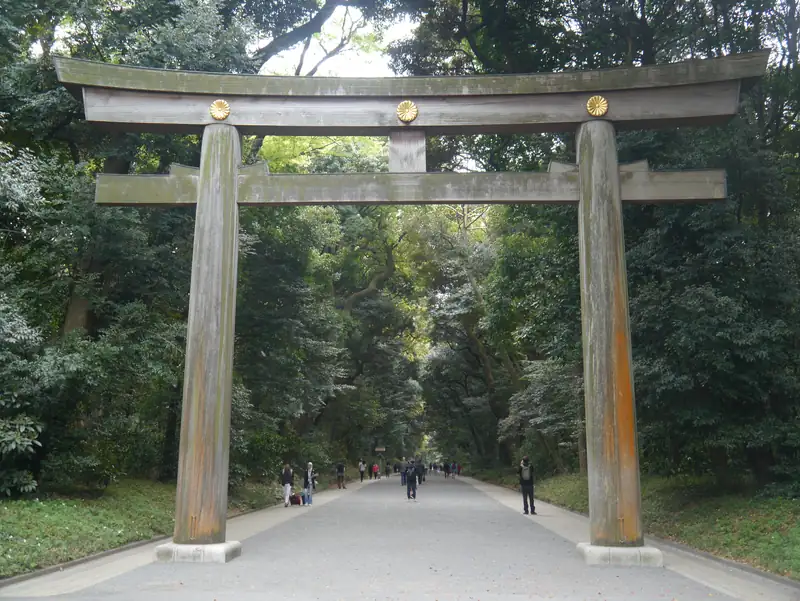
- Meiji Shrine (Meiji Jingu), established in 1920, sits in a 70-hectare forest beside Harajuku. Entry is free, and the gates open at sunrise and close at sunset.
- Yoyogi Park is the 54-hectare park beside the shrine, open at all hours and free. It was the athletes’ village for the 1964 Olympics.
- Omotesando is the zelkova-lined avenue that runs from the Meiji Jingu entrance to Aoyama-dori.
- Ebisu and Daikanyama are south of the station and part of the same ward, each with its own guide.
- Nakameguro is on the Tokyu Toyoko Line, with about 800 cherry trees along the Meguro River nearby.
- Shimokitazawa is under 10 minutes away on the Keio Inokashira Line, for vintage clothes and record shops.
Where to stay and getting around
Shibuya Station is served by JR, Tokyo Metro, Tokyu and Keio lines, and the Shibuya Station guide explains the exits, which are changing as the station is rebuilt. Expect construction hoardings around the station until FY2034, when the redevelopment is due to finish. If you want to stay in the middle of it all, see where to stay in Shibuya.